Showing posts with label unity. Show all posts

Wednesday, October 17, 2012

Unity

The Tower of Babel would seem to have been driven by the most lofty of ideals - unity amongst all mankind. In that way it would appear to be a clone of the Bais HaMikdosh, the Temple in Jerusalem. The Bais Hamikdosh was built on top of the Even Shisiyah, the rock which holds together, unifies, the entire world. The Mishkan, the Tabernacle which preceded the Temple, was formed by pillars with hooks on them. The hooks are called in Hebrew ווין, vovin. Vov is the Hebrew letter that forms a conjunction, the equivalent of the English word "and." The Temple as a place of Connection. The High Priest prayed on Yom Kippur that Hashem should respect the wishes of the community as a whole, over those of a selfish individual.

Why, then, is the unity of the builders of the Tower so disparaged and rejected by God?

Midrash teaches us that as the Temple was built each stone made room for every other stone. Conversely, we see by the building of the Tower that as they tried to fit in the stones, the stones fell down. This alludes to the root of the distinction between the two forms of unity.

In the Bais HaMikdosh the unity was created by each partner to the unity seeing that the other had the space they needed. It was not a forced unity demanding that people fit, whether or not they actually did. On the contrary, efforts were made to see to it that each person had the space they needed to fit in properly. The builders of the Tower, by contrast, had decided that everyone had to be united. And they were determined to do all they could to force-fit everyone into the unity whether or not they really fit where they were place. Such a unity was doomed to failure.

Wednesday, January 26, 2011

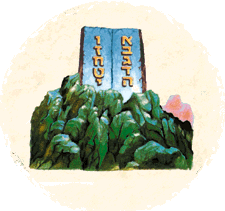
In the first rendition of the עשרת הדברות (Ten Commandments) the last few commandments are stated with no connective words between them: לא תגנוב לא תרצח, Do not steal, Do not murder. In the second rendition, there is the extra letter ו (meaning and) inserted connecting between the words לא תגנב ולא תרצח. Do not steal and do not murder. What is the reason for this distinction?
The Bais Yaakov of Ishbitz explains that this is because the first set were given by directly by God. As a result when God said "Do not steal," these words permeated the entirety of creation. When he next said "Do not murder," those words permeated the entirety of creation. How can it be that each set of words permeated all? Shouldn't it have to be one or the other? This is one of the paradoxes of God which we cannot comprehend, how things that appear to us to be distinct and separate are within Him united and One. But separation is for our world, in God's dimension separation doesn't exist.

This is why the first set of tablets could not possibly last. They were written from God's perspective, not man's. As humans, we lacked the ability to connect to the full concept of unity. The tablets had to be destroyed and a new set made, by man, in which these disparate (from a human perspective) concepts could be strung together and connected, as symbolized by the letter ו, so that each one had its proper time and place.

This would seem to be similar to the Kabbalistic concept of the breaking of the vessels. This concept teaches that at Creation God tried to pour the spiritual power of the Ten Sefirot into vessels to contain them. But it was too much for them, and they broke. It is now the remit of man to collect what spilled out and to repair the broken vessels. These were not Godly errors on the way to creating a world or giving the Torah, but this is an intentional pattern repeated, as we see here, throughout history. And this is true not only on a global and national scale, but also for individuals as well. The Sages teach us that in utero a child is taught all of the Torah; when he is born, he forgets it all. Why bother teaching it to him if he will forget?

The answer is that God instills within the world all of the potential goodness that can possibly exist. He places it there within our reach and gives us the innate intuitive knowledge that we can achieve it. But He will not give it to us. We must take it for ourselves and find the place for every aspect of it. This is because within God there are no divisions; all is One. Only man can divide and by doing so arrange, and conquer.
The Kabbalists explain that this is the goal of all Talmudic study. As simply stated so much of Tanach and the Mishnah seems to be a hodgepodge of half statements and contradictions. We need to order it all to make sense of it, to understand where and how each and every Halacha of the Torah is appropriately applied.
God can't and won't do this for. It is up to man to create the balance.

Thursday, October 30, 2008

Babel

What were the people of the Tower of Babel trying to do? What was so bad about it? Why did they deserve the punishment they received?

A glance at the Torah will show you that the exact crime they committed is not clearly explained. The various commentators offer countless approaches to understand it. I saw an interesting explanation in the Ma'or Va'Shemesh, which offers some thought provoking points. Rather than offering you a translation of his words, I am adapting it and shaping it a bit. He bears no responsibility for what I am writing here if I err.

Avraham Avinu came to teach the world about monotheism, about the unity of One God. Nimrod, the leading proponent of paganism in his time realized that this threatened the hegemony of the pagan gods. He realized the need to combat Avraham's efforts, and to do so he worked to unite all the known people to form a bulwark against Avraham.

There is something ironic about this. The message of One God is in and of itself a message of unity. Ultimately it is only through the understanding that there is one god that man can, and will, come to unity. The pagan message of multiple gods is one that naturally leads itself to disunity and fraction, as there was infighting amongst those gods themselves. Nimrod was using what should have been the tool of Avraham, against Avraham.

He took his people into the tower. I wonder if he was doing that to keep them in, or to keep others out. I see it as sort of a Berlin Wall, striving to keep out the ideas of an Avraham.

God destroyed it as they were using the forces of unity for disunity.It was doomed to failure from the start as it was predicated on an invalid premise.

This should, however, lead those of us who do believe in monotheism to think about our own unity and disunity. Surely unity is where we belong and we should direct our efforts to that end.