Showing posts with label tablets. Show all posts

Wednesday, January 26, 2011

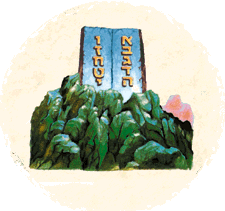
In the first rendition of the עשרת הדברות (Ten Commandments) the last few commandments are stated with no connective words between them: לא תגנוב לא תרצח, Do not steal, Do not murder. In the second rendition, there is the extra letter ו (meaning and) inserted connecting between the words לא תגנב ולא תרצח. Do not steal and do not murder. What is the reason for this distinction?
The Bais Yaakov of Ishbitz explains that this is because the first set were given by directly by God. As a result when God said "Do not steal," these words permeated the entirety of creation. When he next said "Do not murder," those words permeated the entirety of creation. How can it be that each set of words permeated all? Shouldn't it have to be one or the other? This is one of the paradoxes of God which we cannot comprehend, how things that appear to us to be distinct and separate are within Him united and One. But separation is for our world, in God's dimension separation doesn't exist.

This is why the first set of tablets could not possibly last. They were written from God's perspective, not man's. As humans, we lacked the ability to connect to the full concept of unity. The tablets had to be destroyed and a new set made, by man, in which these disparate (from a human perspective) concepts could be strung together and connected, as symbolized by the letter ו, so that each one had its proper time and place.

This would seem to be similar to the Kabbalistic concept of the breaking of the vessels. This concept teaches that at Creation God tried to pour the spiritual power of the Ten Sefirot into vessels to contain them. But it was too much for them, and they broke. It is now the remit of man to collect what spilled out and to repair the broken vessels. These were not Godly errors on the way to creating a world or giving the Torah, but this is an intentional pattern repeated, as we see here, throughout history. And this is true not only on a global and national scale, but also for individuals as well. The Sages teach us that in utero a child is taught all of the Torah; when he is born, he forgets it all. Why bother teaching it to him if he will forget?

The answer is that God instills within the world all of the potential goodness that can possibly exist. He places it there within our reach and gives us the innate intuitive knowledge that we can achieve it. But He will not give it to us. We must take it for ourselves and find the place for every aspect of it. This is because within God there are no divisions; all is One. Only man can divide and by doing so arrange, and conquer.
The Kabbalists explain that this is the goal of all Talmudic study. As simply stated so much of Tanach and the Mishnah seems to be a hodgepodge of half statements and contradictions. We need to order it all to make sense of it, to understand where and how each and every Halacha of the Torah is appropriately applied.
God can't and won't do this for. It is up to man to create the balance.

Tuesday, January 18, 2011

Breaking the Tablets - The Epitome

The final words of the Torah mention about what Moshe did לעיני כל ישראל, before the eyes of all of Israel. To which event is this referring? Our Sages teach us that this refers to Moshe's having broken the Luchos, the two Tablets. It seems very puzzling that this is how the Torah should end, that the crescendo at the conclusion of the Torah should be emphasizing this act of Moshe's. Is this the be-all-end-all summation of his accomplishments?
At the beginning of the Torah we are told that וחושך על פני תהום, and there was darkness on the face of the depths. The ARIZA"L points out that the final letters of that phrase spells out the word כלים, vessels, specifically vessels that are dark. This is an allusion to the well-known Kabbalistic concept of the breaking of the vessels. Namely that God created ten Sefirot, spiritual entities, that form the spiritual building blocks of creation. At Creation God poured the Sefirot into vessels to contain them, however the vessels proved to be too weak, they shattered. The Sefirot and the broken vessels tumbled out and were scattered throughout creation. It is our job to find these lost lights, rebuild the vessels, and by doing so to perfect the world.
This was not a mistake; it was not some Godly blooper of misjudging how much the vessels could handle. Rather, this exemplifies how God created the world. He shows us tantalizing views of what can be and should be, but he leaves it up to us to make it so. He doesn't make it so Himself. But, if he were not to show us what could be, we would never realize what could be and aspire to accomplish it.
The breaking of the Tablets by Moshe was another manifestation of this phenomenon. The first Tablets were made by God Himself. The Nation had not worked on self-perfection to achieve what they saw at Mt. Sinai, God took them out of Egypt and raised them up to levels beyond what they truly were. Since it was not a point they had come to on their own, it was unsustainable. But they had seen and comprehended enough to know what they could become. God took Himself away from them, the people turned to the עגל הזהב (Golden Calf) and Moshe came down and shattered the Tablets.
This was lesson one, you cannot sustain something you have not earned. Lesson two was having Moshe make the new Tablets; not God-like the first ones, this time a human would make them. Only through human hands could they last. This was teaching the Nation the most fundamental lessons of what God wants from us in our lifetimes. This was the lesson of Teshuva, of how to return to God and to repair the world. There was no greater lesson that Moshe could possibly teach us. But this ability to grow, to change, to become and to sustain, required a destruction to precede it; to destroy what God had created and for man to remake it.
This is why the final strains of the Torah allude to Moshe's having broken the Tablets, it was his crowning achievement. There is an allusion to this also in the final words of the Torah: ,משה לעיני כל ישראל, Moshe before the eyes of all of Israel. If you take the first letter of each word, and unscramble them, you once again get the word כלים, vessels. Unlike the allusion to vessels at the beginning of the Torah which we mentioned earlier, which was hinted to with the letters at the end of the words, showing that it was the dark-side of the vessels, this time it is alluded to with the letters at the beginning of the words, to lets us know that Moshe had taught how the vessels can be made whole and proper.